
Ant infestations can turn a comfortable home into a frustration, and fast. Whether it’s a few trails across the kitchen counter or a full-blown colony in the yard, most homeowners reach for ant killer granules as a first line of defense. These small, pellet-like treatments have become a staple in DIY pest control for good reason: they’re accessible, relatively easy to apply, and often effective when used correctly. But not all granules work the same way, and applying them wrong can waste money or leave the problem unsolved. This guide walks through what ant killer granules actually do, how to pick the right formula for the job, and how to deploy them safely and effectively, so the ants disappear and stay gone.
Key Takeaways
- Ant killer granules work through two mechanisms—contact-based insecticides that kill on touch or ingestion-based formulas that worker ants carry to the queen, making colony elimination more effective.
- Choosing the right ant killer granules depends on location (outdoor vs. indoor), ant species, and safety priorities; chemical formulas offer faster results while natural options are safer for pets and children.
- Proper application requires identifying active trails, clearing debris, broadcasting granules evenly around nests, light watering within 24 hours, and reapplication every 6–8 weeks for lasting results.
- Handling ant killer granules safely demands gloves, appropriate storage in labeled containers away from children and pets, and immediate action if accidental ingestion or contact occurs.
- DIY granule treatment works well for light to moderate outdoor infestations, but professional pest control is recommended for carpenter ant invasions, large fire ant colonies, or persistent problems after proper application.
What Are Ant Killer Granules and How Do They Work?
Ant killer granules are small, solid particles, often resembling coarse sand or tiny pebbles, that contain active insecticidal ingredients. Unlike sprays, which deliver a wet mist, granules release their active compounds slowly over time and create a barrier that ants walk through or ingest.
Most granules rely on one of two mechanisms. Contact insecticides kill ants on touch, disrupting their nervous systems the moment they make contact with the granule. Ingestion-based formulas work more gradually: worker ants carry granule particles back to the colony, where the queen and larvae consume the poison. This delayed-action approach is often more effective for eliminating entire colonies because it targets the source, the queen, rather than just the workers foraging outside.
The active ingredients vary. Many conventional products use insecticides like fipronil, imidacloprid, or pyrethroids, which are neurotoxins effective against insects. Natural formulations might contain diatomaceous earth or essential oils that damage exoskeletons or repel ants. The granule base itself, usually clay, sand, or cellulose, holds the active ingredient and helps it spread evenly.
Timing matters. Granules work best when there’s ant activity and moisture to help them stick and disperse. A light rain, watering, or humid conditions help dissolve or break down the granule coating, releasing the active ingredient more effectively.
Choosing the Right Ant Killer Granules for Your Situation
Not every granule product suits every scenario. The right choice depends on where the ants are, what species you’re dealing with, and your comfort level with chemicals.
For outdoor yard infestations, look for granules labeled for broadcast application, these are designed to spread across large areas and create a perimeter barrier. Products containing fipronil or imidacloprid are fast-acting and effective against common outdoor species like fire ants and carpenter ants. Cost typically ranges from $10 to $25 per bag, depending on coverage area (usually 5,000 to 10,000 square feet).
For indoor use, granules are less common, most indoor ant problems respond better to gels or baits. But, if granules are your only option, choose products specifically labeled safe for indoor use, and apply only along baseboards and exterior entry points, never on food preparation surfaces.
Pet and child safety is non-negotiable. If the area will see foot traffic from kids or pets, natural or low-toxicity granules may be the better call, even if they work slightly slower. Read the label: it should state whether it’s safe around pets after application and drying.
Chemical vs. Natural Formulations
Chemical granules (fipronil, imidacloprid, permethrin) typically work faster and cover larger areas efficiently. They’re effective against multiple ant species and generally less expensive. The tradeoff: they’re toxic to humans and pets if ingested, so careful application and storage are essential.
Natural granules often use diatomaceous earth (food-grade), neem oil, or clove and cinnamon extracts. These are safer around kids and pets but may require more frequent reapplication and typically cover smaller areas. They’re gentler on beneficial soil organisms, which matters if the treatment area borders gardens or native plantings.
Neither is inherently “better”, it depends on your priority. If speed and coverage are critical and the area is secure from pets and children, a chemical formula may be the practical choice. If safety and minimal environmental impact are paramount, natural options are worth the extra time and reapplication.
Application Tips for Maximum Effectiveness
Correct application separates success from wasted product. Here’s how to deploy ant killer granules like a pro:
1. Identify active trails and nesting areas. Spend 10–15 minutes watching where ants move and congregate. This tells you where to focus your granules. Signs of a nest include mounded soil, piles of excavated dirt, or cracks where ants emerge.
2. Prepare the area. Remove debris, dead vegetation, and organic matter from the application zone. Granules need direct contact with soil or the ant pathway to work. A light rake or broom clears the way.
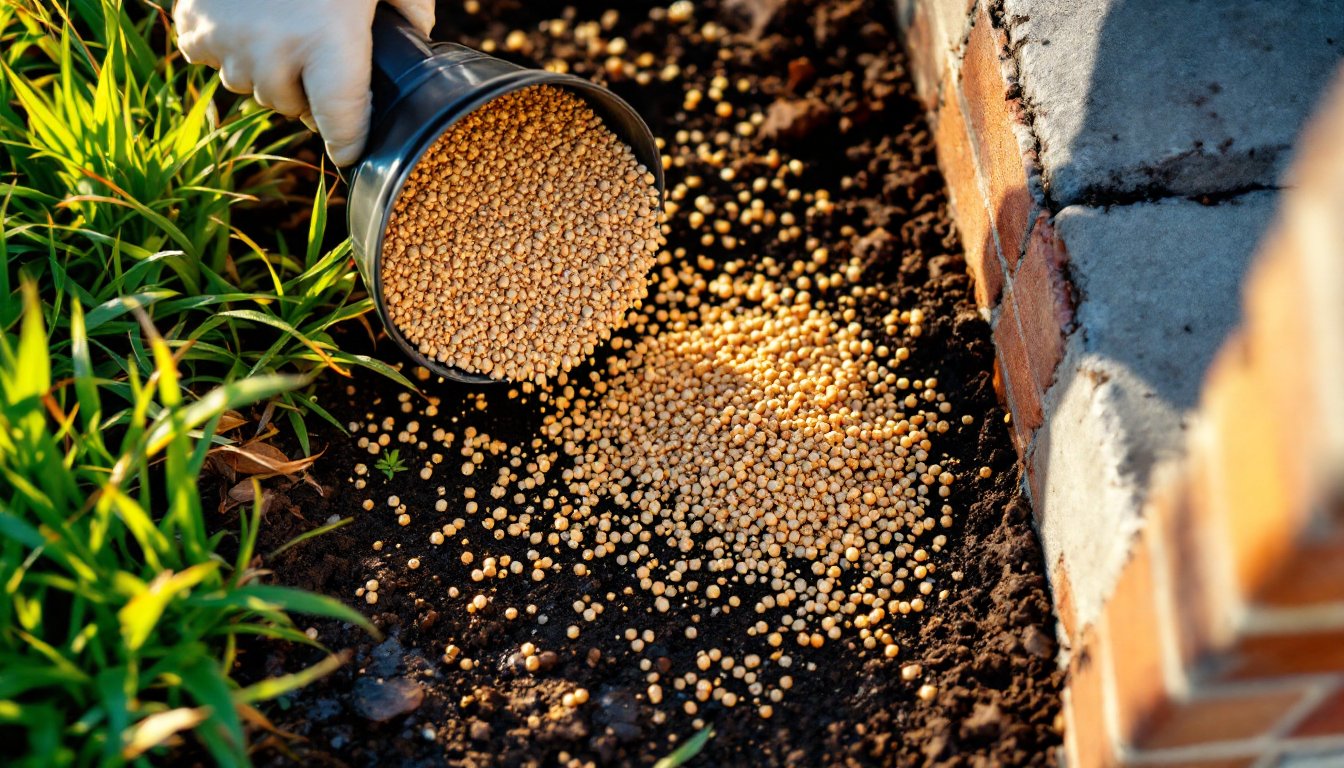
3. Apply granules evenly around nests and along trails. Broadcast the granules by hand (wearing gloves) or use a spreader for uniform coverage. For yard perimeter treatments, apply a band 3 to 6 feet wide around the foundation or property edge. Don’t oversaturate, the label rate is there for a reason.
4. Water lightly after application. A light sprinkle (not a full soak) helps activate the granules and carries them into the soil. Most labels recommend light watering within 24 hours. Too much water can leach the active ingredient away before ants encounter it.
5. Reapply as directed. Most granules remain effective for 4 to 8 weeks. If ant activity returns, reapply according to the label, usually after 6–8 weeks or following heavy rain that may have washed the granules away.
Timing: Apply granules in early morning or late evening when ants are most active. Avoid midday heat, which may reduce worker activity.
Safety Considerations When Using Ant Killer Granules
Ant killer granules contain active ingredients designed to kill insects, so they demand respect and care during handling and storage.
Personal protective equipment (PPE): Wear nitrile or latex gloves when handling and applying granules, avoid bare-hand contact. A long-sleeved shirt and pants protect skin, especially if the area is brushy. Safety glasses prevent accidental contact with eyes, which is rare but serious.
Inhalation risk: Most granules are solid, not aerosolized, so inhalation is low-risk if applied outdoors with decent air movement. If applying in an enclosed space (very unusual), wear an N95 mask and ensure good ventilation.
Storage: Keep granules in a cool, dry place in their original labeled container. Store away from children and pets, a locked cabinet or shed is ideal. Never transfer granules to unmarked containers or food storage bags. If spilled, sweep up promptly and dispose according to label instructions.
Accidental ingestion or skin contact: If a child or pet ingests granules, contact Poison Control (1-800-222-1222 in the US) or your veterinarian immediately. For skin contact, rinse thoroughly with water. Most labels are safe to ingest in small amounts after drying, but always verify on the product label.
Environmental precautions: Don’t apply near surface water, wells, or areas where runoff will reach aquatic habitats. Check local regulations, some jurisdictions restrict certain active ingredients near sensitive areas. Natural granules are lower-risk but still warrant careful placement.
When to Call a Professional vs. DIY Treatment
Ant killer granules work well for many infestations, but some situations demand professional expertise.
DIY granules are appropriate when:
- Ants are confined to a yard or exterior perimeter.
- The infestation is light to moderate (visible trails but no wall damage or massive colonies).
- You have access to the affected area and can apply granules safely.
- The problem is recent and hasn’t spread throughout the home.
Call a professional when:
- Carpenter ants have colonized inside walls or structural wood, they cause real damage, and granules alone won’t reach them. A licensed pest control operator can inspect, locate nests, and deploy targeted treatments.
- Fire ants have established multiple large mounds across a large property, bulk treatment and follow-up management are best left to pros.
- Ants persist even though 2–3 weeks of proper granule application, this signals a deeper infestation or a species that requires different tactics.
- You’re renting or the property is under HOA management, treatment may need documentation and coordination.
A professional inspection costs $150 to $300 but can save thousands in property damage and months of guesswork. Pest control companies often guarantee their work too, so if ants return within 30 days, they retreat at no charge.
Conclusion
Ant killer granules are a practical, cost-effective first defense against yard and perimeter ant infestations when applied correctly. Success hinges on selecting the right formula for your situation, applying granules to active trails and nests, and following safety guidelines closely. For straightforward outdoor infestations, DIY granule treatment delivers results. If carpenter ants have invaded the home, or if granules don’t solve the problem within a few weeks, a licensed pest control professional is worth the investment. Either way, patience and attention to the label instructions make the difference between a solved problem and ongoing frustration.