
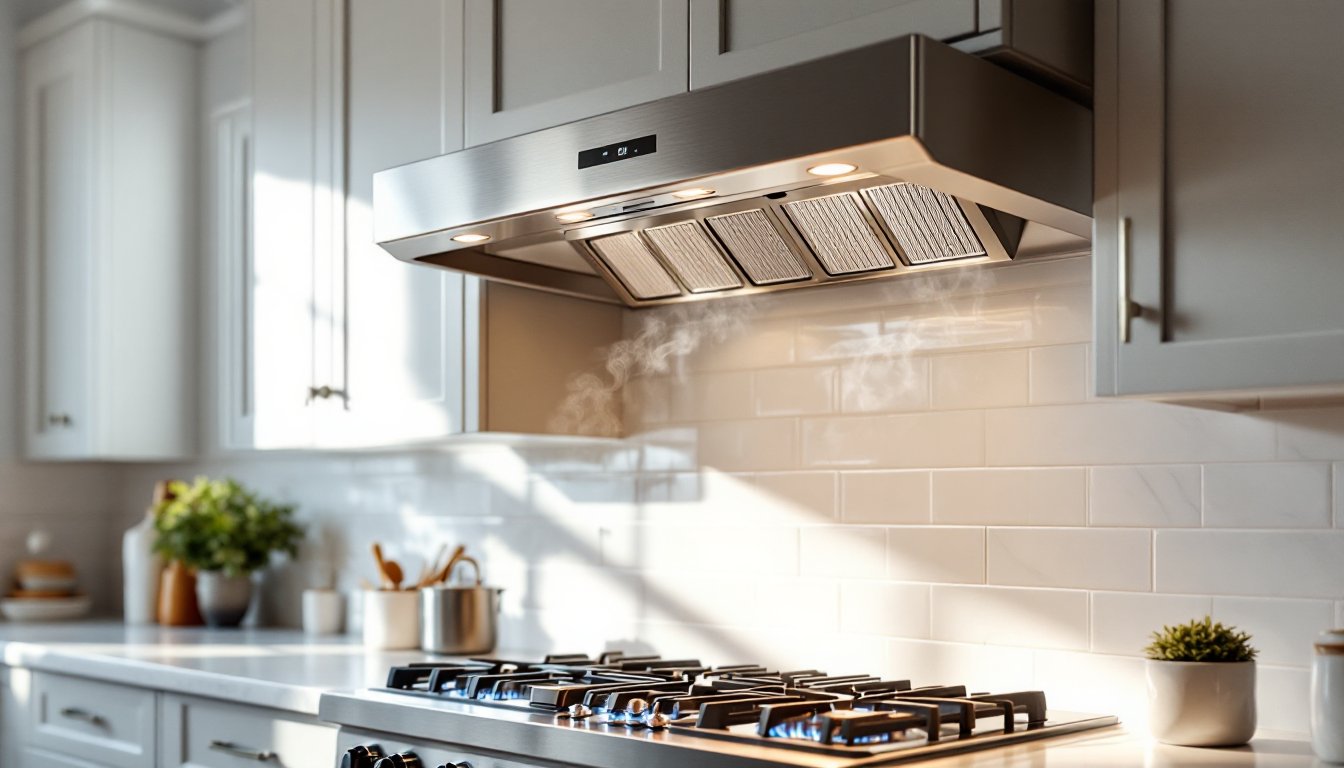

A range hood that actually works while keeping utility bills under control sounds too good to be true, until you look at the numbers behind Energy Star certified models. These hoods pull the same moisture and odors from your kitchen as standard units, but they use up to 25% less energy by running smarter motors and more efficient fans. For a homeowner tackling a kitchen remodel or just replacing a worn-out hood, an Energy Star range hood delivers real savings without compromise. The certification means the hood has been independently tested to meet strict federal efficiency standards, so there’s no guesswork involved.
Key Takeaways
- Energy Star range hoods use up to 25% less energy than standard models by employing electronically commutated motors and optimized blower designs that adjust speed based on cooking activity.
- Long-term savings from an Energy Star range hood can reach $60–$225 over 10–15 years, plus utility rebates of $50–$200 reduce upfront costs by 10–25%.
- Energy Star certification guarantees quiet operation at 0.5 sones (roughly 50 decibels), significantly quieter than standard hoods running at 65–75 decibels.
- Over its lifetime, an Energy Star range hood prevents 500–1,000 pounds of CO2 emissions compared to a standard model, supporting environmental sustainability goals.
- Proper ductwork design—using 6–8 inch rigid ducts with minimal bends—is essential to maximize the performance and efficiency benefits of your Energy Star range hood.
- Most residential kitchens require 400–600 CFM ventilation capacity; verify your hood’s specifications match your cooktop size and kitchen layout before purchasing.
What Makes an Energy Star Range Hood Different
An Energy Star range hood isn’t just a cosmetic tweak to a standard model. It uses a combination of design improvements and component upgrades that work together to cut energy waste. Most notably, these hoods feature electronically commutated motors (ECMs) instead of the older AC motors found in budget units. ECMs adjust speed automatically based on cooking activity, so the fan doesn’t run at full throttle when you’re just simmering soup.
The blower wheel design is also optimized to move air more efficiently through the duct system. A standard 6-inch duct might require a loud, power-hungry motor to push air outside: an Energy Star unit achieves the same airflow, measured in cubic feet per minute (CFM), with less effort. Add in better sealing at motor connections, improved filter designs that don’t choke airflow, and you’ve got a hood that works harder while consuming less electricity.
Energy Star certification also requires that the hood operate at or below 0.5 sones when running at its highest speed. That’s a measure of loudness: for context, normal conversation is around 60 decibels, while 0.5 sones (roughly 50 decibels) is noticeably quieter than older range hoods.
Key Benefits of Choosing an Energy Star Certified Hood
Lower Energy Consumption and Utility Bills
The math on energy savings is straightforward. A typical range hood runs 1-2 hours per day in an average household. Standard models draw 200–400 watts: an Energy Star hood pulls 150–300 watts for the same ventilation. Over a year, that’s roughly 50–100 kilowatt-hours saved, which translates to $6–$15 annually in reduced electricity costs depending on your local rate. That doesn’t sound dramatic until you multiply it by 10-15 years, the typical lifespan of a quality hood. You’re looking at $60–$225 in cumulative savings, with no effort on your part after installation.
Better yet, many utilities offer rebates for Energy Star appliances, sometimes $50–$200 per unit. Check with your local electric company or state energy office before buying: the rebate can cover 10–25% of the purchase price.
Environmental Impact and Sustainability
Lower energy use means reduced demand on the power grid and fewer carbon emissions from electricity generation. If your grid draws power from fossil fuels, an Energy Star hood prevents roughly 500–1,000 pounds of CO2 emissions over its lifetime compared to a standard model. That’s equivalent to planting a few trees and letting them grow for years. For homeowners who care about their environmental footprint, the choice aligns personal use with broader climate goals without requiring sacrifice or inconvenience.
Comparing Energy Star Hoods to Standard Models
Here’s where the practical differences show up. A standard 30-inch range hood with a basic AC motor costs $150–$400 and runs at full speed whenever the switch is on. It’s louder (often 65–75 decibels), less responsive to cooking conditions, and less efficient at moving air through restrictive ducting. Installation is simple because it doesn’t require any special wiring or controls beyond a basic on-off switch and a damper to prevent backflow.
An Energy Star 30-inch hood typically costs $300–$700, roughly 50–100% more upfront. But you get variable-speed operation, quieter motors (50–60 decibels), faster response to humidity sensors in some models, and warranty coverage that often exceeds what you’d find on budget options. The payback period on the premium, accounting for rebates and utility savings, is usually 5–10 years, after which all savings go straight to your bottom line.
Ductwork matters too. If you’re replacing an old hood with a new Energy Star model in the same location, you may inherit outdated ducting (undersized, kinked, or with poor damper design). Taking time to upgrade or repair the ductwork, even simple fixes like sealing joints with duct tape or adjusting duct routing, amplifies the efficiency gains and lets the hood perform to spec. A poorly ducted Energy Star hood won’t deliver its full potential.
How to Choose the Right Energy Star Range Hood for Your Kitchen
Start with the basics: CFM requirement and hood type. CFM stands for cubic feet per minute, and it tells you how much air the hood can exhaust. Most residential kitchens need 400–600 CFM, but that depends on cooktop size, cooking frequency, and whether the kitchen is open to the rest of the home. An isolated kitchen with a standard 4-burner electric range might get by with 400 CFM: an open-concept kitchen with a 6-burner gas range should aim for 600+ CFM. Check the hood’s spec sheet, not just the price tag, to confirm it matches your needs.
Next, choose your hood type: under-cabinet, island, or wall-mount chimney. Under-cabinet hoods are the most common retrofit option and fit snugly below cabinet soffits. Island hoods suit kitchens with a central cooking surface and require ductwork to pass through the ceiling and roof. Chimney hoods mount on the wall above a cooktop and work well in traditional or chef’s kitchens. Each style has Energy Star-certified options: the difference is installation complexity and visual impact.
Ducting is critical. If you’re installing a new hood, use minimum 6-inch diameter ductwork for 400–600 CFM systems: 8-inch is better for higher-CFM hoods. Flex duct is easier to route but creates air resistance: rigid aluminum or steel ducting performs better. Route the duct as straight as possible, minimize bends, and terminate outside the home with a roof damper or wall cap that prevents backdrafts when the hood isn’t running.
Finally, check that the hood has moisture and odor control. Some Energy Star models include humidity sensors that automatically ramp up fan speed, or carbon filters for recirculating designs. Baffle filters (curved metal pieces) are easier to clean than mesh filters and perform better in greasy kitchens. If ventilation is ducted outside, baffle filters trap grease before it enters the ductwork, saving you from cleaning ducts every few years.
Conclusion
An Energy Star range hood is a practical, cost-effective upgrade that keeps your kitchen comfortable while cutting energy waste. The upfront cost is higher than a basic model, but utility rebates and years of lower bills make up the difference. More importantly, it removes odors and humidity as well as a standard hood while operating quietly and responsibly. If you’re planning a kitchen remodel or your current hood is aging, Energy Star certification is worth the investment.